


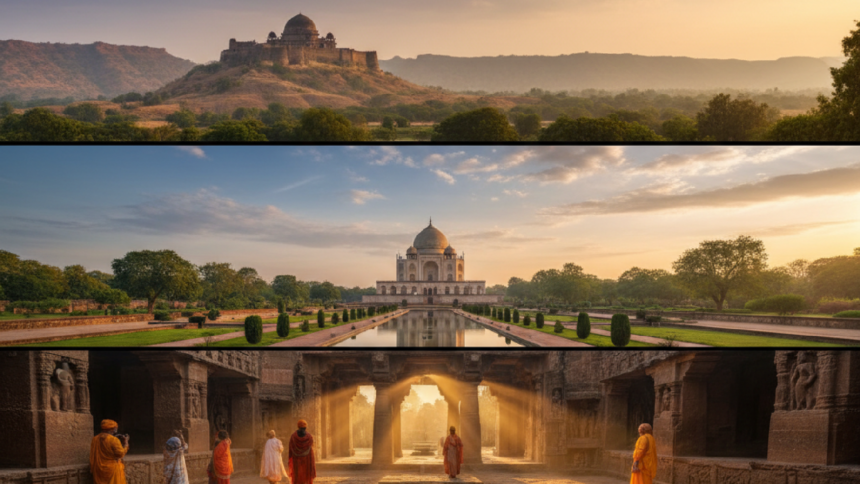
Top 10 Tourist Places in Aurangabad You Can’t Miss
You ever feel like you’re walking through a history book that actually breathes? That’s Aurangabad for you. Most people just treat it as a quick stopover for the caves, but they’re missing the soul of the place. Honestly, if you want to see the real Maharashtra, you have to spend time here.
Finding the top 10 tourist places in Aurangabad isn’t just about ticking boxes on a map. It’s about standing in the shadow of forts that never fell and temples carved out of single rocks. It’s hot, it’s dusty, and it’s absolutely magnificent.
Whether you’re a history nerd or just someone who wants a cool Instagram backdrop, this city delivers. I’ve put together this guide to help you navigate the chaos and find the gems.
What to Expect in This Guide
- The Grandeur of Ajanta and Ellora
- Mughal Architecture and “Mini Taj”
- The Unbeatable Daulatabad Fort
- Hidden Spiritual and Natural Spots
- Planning Your Aurangabad Itinerary
Exploring the Ajanta and Ellora Caves
You can’t talk about the top 10 tourist places in Aurangabad without starting here. It’s the law of travel in India. These aren’t just caves; they are ancient engineering miracles.
The Artistic Wonders of Ajanta Caves
Ajanta is about two hours from the city. It’s a horseshoe-shaped cliff filled with 30 rock-cut Buddhist caves. The paintings here are almost 2,000 years old.
Think about that for a second. No electricity, no modern tools, just monks and artists working by reflected sunlight. The murals tell stories of the Buddha’s past lives. The colors, derived from minerals and plants, still glow. It’s quiet, spiritual, and a bit humbling.
The Engineering Feat of Ellora Caves
Ellora is closer to the city and offers something different. While Ajanta is about paintings, Ellora is about massive sculpture. It features 34 caves representing Buddhism, Hinduism, and Jainism.
The star of the show is Cave 16, the Kailasa Temple. It’s the largest monolithic structure in the world. They carved it from the top down. Imagine a giant block of basalt and someone saying, “I’m going to turn this into a multi-story temple with elephants and galleries.” And they did. It took 18 years and shifted 200,000 tonnes of rock.
The Royal Legacy of Bibi Ka Maqbara
People call this the “Poor Man’s Taj” or the “Taj of the Deccan.” That feels a bit mean, really. Built by Prince Azam Shah for his mother, Rabia-ud-Daurani, it’s a stunning piece of Mughal architecture.
It definitely looks like the Taj Mahal, but it has its own charm. The marble is concentrated on the main dome and the rest is high-quality plaster. When the sun hits it during the golden hour, the whole place turns a soft, warm pink.
It’s one of the most accessible top 10 tourist places in Aurangabad because it’s right in the city. You can walk the gardens, look at the intricate lattice work, and forget about the traffic outside the gates for an hour.
The Unconquerable Daulatabad Fort
If you like a bit of adventure, this is your spot. Daulatabad Fort is a massive hilltop fortress that was once the capital of India for a brief, chaotic stint under Muhammad bin Tughluq.
This place was designed to be impossible to capture. It has three layers of walls, a deep moat filled with crocodiles (back then, anyway), and a dark, winding tunnel called the “Andhari.”
Walking through the Andhari is a trip. It’s pitch black, full of bats, and designed to trap invaders with smoke and boiling oil. Today, you just use your phone flashlight and try not to trip. The view from the top is worth the 750-odd steps. You see the whole Deccan plateau stretching out, and you feel like a king for a minute.
Panchakki and the Medieval Water Mill
This is a quirky one. Panchakki is basically a 17th-century water mill. It was designed to generate energy to grind grain for pilgrims visiting the nearby shrine.
The engineering is actually pretty cool. It uses an underground clay pipe system to bring water from a spring kilometers away. There’s a big reservoir and a massive banyan tree that’s probably seen more history than all of us combined. It’s a peaceful place to sit and watch the water flow. It shows how smart people were long before we had fancy computers.
Grishneshwar Jyotirlinga Temple
Just a stone’s throw from the Ellora Caves is this ancient temple. It’s one of the 12 Jyotirlingas dedicated to Lord Shiva in India. Even if you aren’t particularly religious, the vibes here are intense.
The temple was destroyed and rebuilt several times, with the current structure dating back to the 18th century. The red stone carvings are incredibly detailed. One thing to note: men have to take off their shirts to enter the inner sanctum. It’s a local tradition, so just roll with it. The queue can be long, but it moves fast.
The Gates of Aurangabad
Did you know Aurangabad is known as the “City of Gates”? There used to be 52 of them. About 13 are still standing in various states of repair.
Driving through the city, you’ll suddenly see a massive stone archway looming over the road. Bhadkal Gate and Delhi Gate are some of the most famous. They aren’t just ruins; they are functional parts of the city’s modern layout. It’s a weird, cool mix of the 1600s and 2024. Seeing these structures is a reminder of why this city is on the list of top 10 tourist places in Aurangabad.
Aurangabad Caves and the Hidden View
While everyone rushes to Ajanta and Ellora, these caves are often ignored. They sit on a hill behind Bibi Ka Maqbara. There are 12 Buddhist caves here dating back to the 6th and 7th centuries.
Because they aren’t as famous, they are way less crowded. You can actually hear yourself think. The carvings of the dancing figures in Cave 7 are particularly beautiful. Plus, the view of the city from here is the best you’ll find. You can see the white domes of the Maqbara standing out against the city skyline.
Salim Ali Lake and Bird Sanctuary
Need a break from all the stone and dust? Head to Salim Ali Lake. It’s right in the middle of the city but feels like a different world.
Named after the famous “Birdman of India,” this lake is a haven for migratory birds during the winter. It’s a great spot for a morning walk. The local government has added a small garden and a walkway. It’s not the wildest nature spot, but it’s a nice breath of fresh air when the city noise gets to be too much.
Shopping for Paithani and Himroo
You can’t leave without checking out the local crafts. Aurangabad is famous for Himroo fabrics—a blend of silk and cotton with a rich, velvety feel. It was originally made for royalty.
Then there’s the Paithani saree. These are hand-woven masterpieces with peacock motifs and gold borders. A real one takes months to make and costs a fortune, but even just watching the weavers work in the local centers is an experience. It’s a living tradition that’s survived centuries.
The Calm of H2O Water Park and Siddharth Garden
If you’re traveling with kids, they’re going to get bored of old rocks eventually. It’s just how it is. Siddharth Garden and Zoo is a popular local hangout. It has big lawns, a small zoo, and a musical fountain in the evening.
For something more active, H2O Water Park is a decent shout. It’s located near the Daulatabad Fort area. It’s not exactly a “historical” site, but on a 40-degree Celsius afternoon, a waterslide feels like the best invention in human history.
Getting the Most Out of Your Visit
So, how do you actually see the top 10 tourist places in Aurangabad without burning out?
First, don’t try to do Ajanta and Ellora on the same day. You’ll hate yourself. Ajanta needs a full day because of the travel time. Ellora can be combined with Daulatabad Fort and Grishneshwar Temple since they are all in the same direction.
Second, hire a car. Public transport exists, but it’s a bit of a scramble. Having a driver who knows the roads saves you a lot of stress. Also, drink more water than you think you need. The Deccan sun is no joke.
Best Time to Visit
October to March is the sweet spot. The weather is pleasant, and you won’t melt while climbing the fort. If you visit in the monsoon, the landscape turns incredibly green, and the waterfalls at Ajanta start flowing, which is a sight to see.
Food You Must Try
You’re in the land of Naan Qalia. It’s a spicy meat curry served with a special kind of leavened bread. It’s heavy, delicious, and very Aurangabadi. Also, look for the local street food near Gul Mandi.
Making Memories in the City of Gates
Aurangabad is one of those places that sticks with you. It’s not as polished as Mumbai or as flashy as Pune. It’s a bit rough around the edges, but that’s why it feels real.
Standing in a cave that took 500 years to finish makes your daily stresses feel pretty small. Climbing a fort that stood against empires makes you feel a bit more resilient.
When you visit the top 10 tourist places in Aurangabad, you aren’t just looking at old stuff. You’re seeing the ambition of people who lived centuries ago. It’s a reminder that we all want to build something that lasts.
So, when are you packing your bags? There’s a giant rock-cut temple and a spicy plate of Qalia waiting for you. Honestly, just go. You won’t regret it.
Have you ever visited a place that felt like stepping back in time? Or maybe you have a favorite spot in Aurangabad I missed?